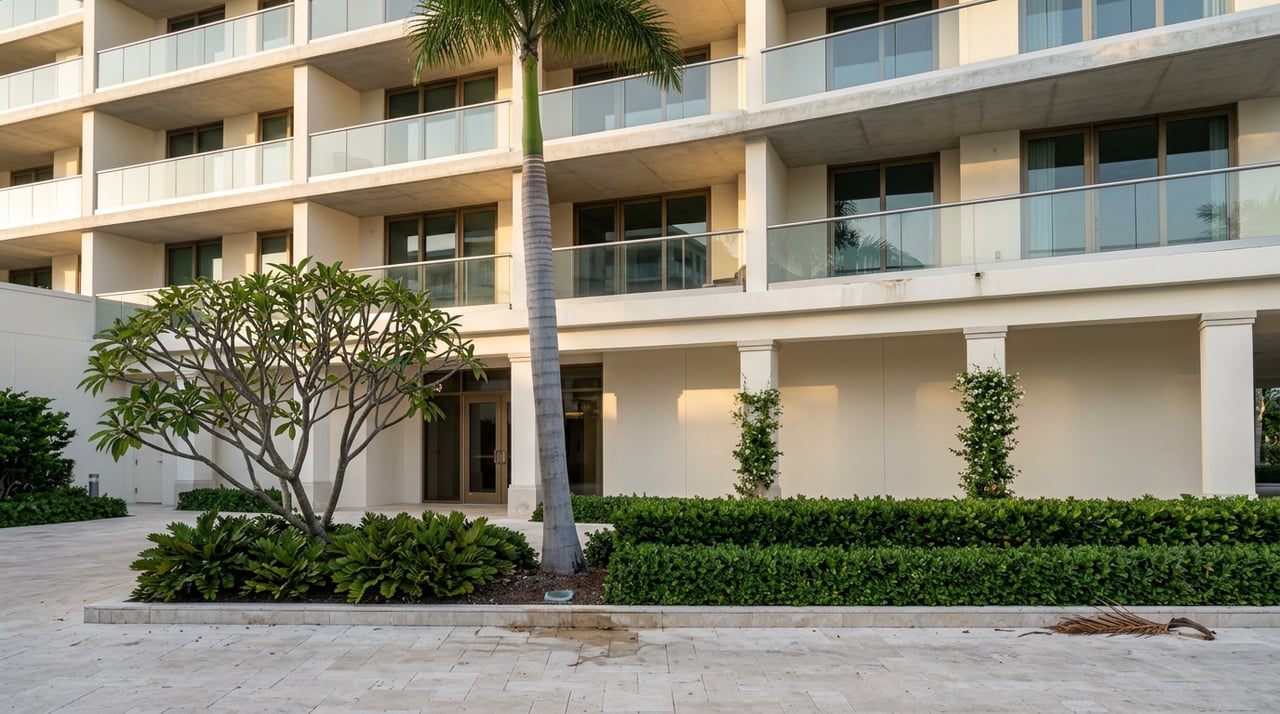
Boca Raton Condo Prices Are Climbing. Getting a Loan Just Got Harder.
Ask most people how Boca Raton real estate is doing this year and they will point to the same number: average sale prices across the city climbed 15.67% year to date through the first quarter of 2026. That number is real. It is also citywide, blending single-family estates with condos, and it is the wrong number if you are trying to figure out whether the specific condo you like can actually close.
The condo market in Boca Raton right now is not one market moving up. It is two markets moving in opposite directions, and the line between them has almost nothing to do with price point, school zone, or how recently the lobby was renovated. It runs through a document most buyers never ask to see: the building's reserve study.
Look past the headline appreciation number and the picture gets more interesting. As of August 2026, the median list price for condos and co-ops in Boca Raton sat at $349,950, down from $359,250 the same month a year earlier. Single-family list prices, meanwhile, jumped from roughly $1,049,450 to $1,399,000 over that same stretch. One product type is pulling the city's average up. The other is quietly sliding.
Segment the condo market further and the split gets sharper. Entry-level and mid-range condos in the $250,000 to $500,000 range, the buildings that saw bidding wars in 2022, are now sitting on three to five months of inventory, with days on market stretched to 50 to 75 days and price reductions of 5 to 8% off 2023 peaks. Single-family homes in established neighborhoods in the $500,000 to $1.5 million range are moving faster, with two to three months of inventory and 35 to 45 days on market. The condo segment isn't cooling because buyers stopped wanting Boca Raton. It's cooling because a growing number of buildings can no longer be financed the normal way.
The instinct is to assume newer construction sidesteps all of this. It doesn't, and that's the part worth sitting with. Florida's Structural Integrity Reserve Study requirement applies to any residential condominium building three or more habitable stories tall, regardless of when it was built. A tower that finishes construction next year still needs a SIRS on file and still has to fund reserves for eight structural components: roof, load-bearing walls, floors, foundation, fireproofing, plumbing, electrical, and waterproofing.
That means buildings like Glass House Boca Raton, the nine-story tower rising at 280 E. Palmetto Park Road with a $70 million construction loan behind it, or the newly approved 76-unit residential tower going up on The Boca Raton resort's property at 501 E. Camino Real, carry the same reserve-funding obligation as a 1980s tower on the barrier island. Height triggers the requirement. Age only adds a second, separate clock on top of it.
That second clock is the one hitting older East Boca inventory hardest. Statewide, buildings need a milestone inspection at 30 years. But local enforcement agencies can pull that trigger earlier for coastal buildings, and Palm Beach County has: buildings within three miles of the coastline must complete their first milestone inspection at 25 years instead of 30. Most of Boca Raton east of I-95, including the corridor along A1A and near the Boca Raton Inlet, falls inside that zone. Salt exposure and chloride-driven corrosion of reinforcing steel are the specific structural risks engineers flag most often in that stretch, and it happens to overlap with the city's heaviest concentration of 1980s and 1990s condo construction.
The Palm Beach County Building Department and the City of Boca Raton Building Division track these deadlines and send notification letters as buildings approach them. If a building's certificate of occupancy predates 2001, it's likely already inside the compliance window, whether or not the board has acted on it yet.
Here is the mechanism that actually connects the building's structural timeline to your mortgage. On March 18, 2026, Fannie Mae and Freddie Mac jointly issued new condo project standards, and the most disruptive piece of that update took effect August 3, 2026, just weeks before this was written. Fannie Mae's Limited Review and Freddie Mac's Streamlined Review, the fast-track paths that let strong borrowers skip a deep look at a building's finances, are retired. Nearly every condo project with more than 10 units now requires a Full Review of the association's budget, reserves, insurance, delinquencies, and litigation history before a conventional loan can close.
The same update raised the minimum reserve allocation associations must budget from 10% to 15% of annual assessment income. Fall short of that line, without a qualifying reserve study to offset it, and the building can be marked ineligible for conventional financing.
That status has a name in the industry, even though it isn't official Fannie Mae or Freddie Mac language:
A "non-warrantable" building is one where Fannie Mae or Freddie Mac won't purchase a conventional loan on any unit inside it, regardless of that individual buyer's credit or down payment. The building's finances, not the borrower's, decide the outcome.
Buyers in a non-warrantable building are pushed toward portfolio or non-conforming loans, which typically carry larger down payments and higher rates, or toward all-cash purchases. That shrinks the buyer pool for every unit in the building, which is the actual mechanism behind those 5 to 8% price reductions showing up in the entry-level condo segment. It isn't that buyers stopped wanting those units. It's that fewer buyers can finance them.
One piece of the same update is worth flagging for anyone thinking about a Boca Raton condo as a rental investment. The rule capping financing eligibility once more than 50% of a building's units were non-owner-occupied has been retired for established projects under Full Review. That opens up buildings with heavier investor concentration to conventional financing again, though it says nothing about whether that building's own bylaws allow short-term rental. Those are two separate questions, and both are worth answering before you write an offer.
The documents that answer both questions are the same ones a lender's Full Review examines. Ask the listing agent or the association for these before you get emotionally attached to a unit:
Florida's Division of Condominiums, Timeshares, and Mobile Homes now requires boards to submit completed SIRS data electronically within 45 days of completion, and that data is searchable through the state's own inspection portal. It's a five-minute check that tells you more about a building's financing risk than the listing photos ever will.
If you're mid-contract on a Boca Raton condo right now, the August 3 change matters even if your lender started the file before that date. Ask directly whether your loan application will be reviewed under the old Limited Review standard or the new Full Review requirement, and whether your building's reserve allocation and insurance deductible clear the new thresholds. A building that financed easily a year ago may not clear them today, and finding that out during underwriting instead of before you signed is the version of this story nobody wants.
Does this affect single-family homes in Boca Raton? No. The SIRS and milestone inspection requirements apply specifically to condominium and cooperative buildings three or more habitable stories tall under Florida Statute Chapter 718. Single-family homes fall under different HOA rules and aren't subject to these structural reserve mandates.
Can I still buy in a non-warrantable building? Yes, with cash or a portfolio loan from a lender willing to hold the mortgage on its own books rather than sell it to Fannie Mae or Freddie Mac. Expect a larger down payment and a higher rate than you would get on a warrantable building.
Is a brand-new building automatically safer? Not automatically. New construction still needs a SIRS on file and still has to meet the same 15% reserve funding threshold. What protects you is the association's financial discipline, not the building's age.
None of this is legal or financial advice, and every building's situation is specific enough that it deserves its own look before you sign anything.
If you're weighing a Boca Raton condo purchase, whether as a primary residence or as part of a short-term rental portfolio, this is exactly the kind of building-level homework Isabela Faria walks clients through before an offer goes in, not after. Schedule a consultation and get a clear read on a specific building's reserve health, financing eligibility, and rental restrictions before you compete for a unit that might not close the way you expect.



Whether buying or selling, Isabela delivers service beyond comparison. Isabela works closely with each of her clients to find their ultimate property in the most premier locations, and secures the best deal. When listing a property, Isabela maximizes each property’s market value with her unmatched marketing strategy.
Let Me Know How I Can Assist You
ISABELA FARIA-NEWELL
7401 Wiles Rd., Suite #236 Coral Springs, Fl 33067